
How to Build an Engineering Career Path
A good career path shows what great engineers achieve and how they behave, in lines short enough to remember. This post walks through each step in order, so you can build your own. No post can tell you what your company needs. Do your own research first, then use these steps to turn it into a path.
- Call it a path, because people move sideways as well as up.
- Research your own company first, then decide what the path is for before you write a single line.
- Write the most senior level first, then work down one level at a time.
- Rank a few outcomes and the traits under them, and leave out tasks, tools and code.
- Make each level add to the one below, and give each level an example for every trait.
- Test the first version with managers and engineers.
- Allow anonymous feedback from day one, and keep a changelog of every change.
- Write a guide, then train each manager one to one on how to teach the path.
- Teach engineers to use the path to grow, and managers to use it in reviews, career talks and calibrations.
- Use the path to plan growth, never as a checklist to tick off.
I asked engineers and their managers what would make their work better, and one answer stood out. They wanted a clear, shared picture of what the company expects at each level. They also wanted to know what it takes to reach the next step.
Almost every problem I see comes from poor communication or from expectations that don't match. For a leader, few things give a better return than clarity, direction and alignment. A career path is one of the tools that gives all three.
Every engineer should see what good looks like at their level and at the next one. They shouldn't need to ask their manager. The same rules should apply to everyone, written down and shared openly. I call the opposite "hidden or shadow expectations": rules that exist in a manager's head and nowhere else.
I often tell my engineers not to rely on their manager to manage their career. Your career is your own responsibility. Your manager's job is to create an environment where you can do your best work. They give you chances to learn, grow and practise, and they put you forward for the next step. They also speak for you in rooms you are not in.
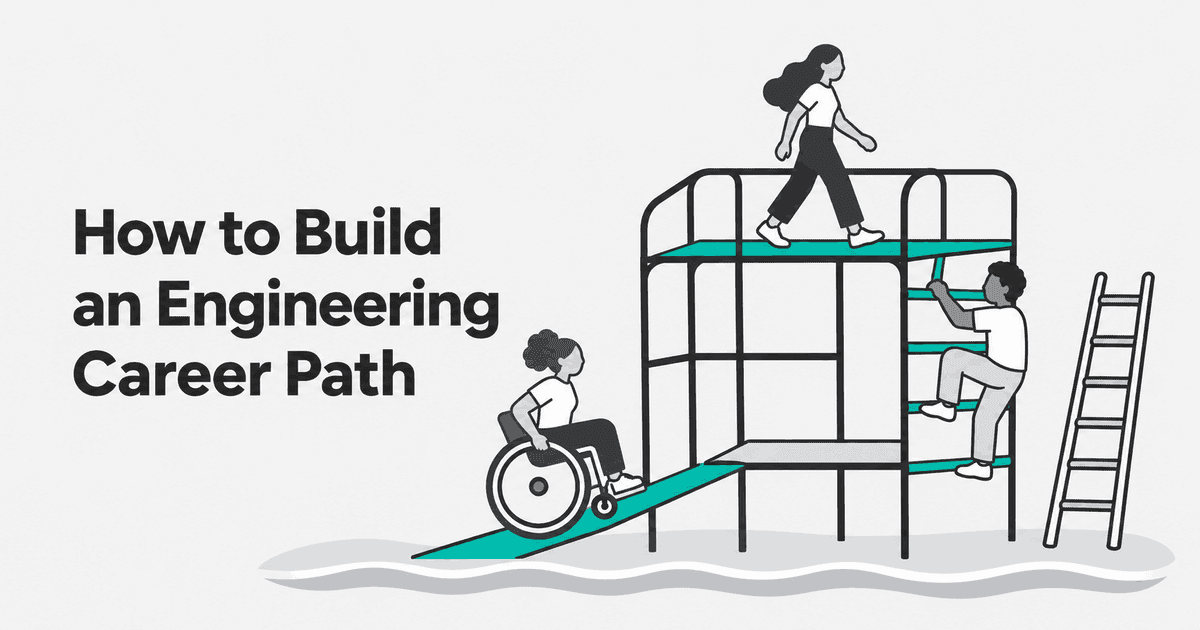
Companies call it many things: a career ladder, a career framework, a progression framework, a levelling guide or a rubric. They all describe what the company expects at each level. I call it a career path, because a ladder only goes up. Pattie Sellers of Fortune found a better image, and Sheryl Sandberg made it famous in Lean In: "Careers are a jungle gym, not a ladder." People move sideways and back to collect the experience they need. That experience gets them to the role where they do their best work.
Do your own research first
Get smart on the topic before you write anything. Learn your own company's context: how it works, what it needs and what its people ask for. Then read widely and talk to people outside it. Nobody else can do this research for you, and the steps in this post only help if you do it.
For example, I interviewed leaders and engineers inside my own company, and CTOs, VPs and staff engineers at other tech companies. I read books on empowered teams, such as Marty Cagan's Empowered and Transformed and Josh Seiden's Outcomes Over Output. I also read Sense and Respond by Jeff Gothelf and Josh Seiden, and Team Topologies by Matthew Skelton and Manuel Pais. On staff engineering, I read Will Larson's Staff Engineer and Tanya Reilly's The Staff Engineer's Path.
I also compared career ladders from other companies, asked my network and mentors, and pulled in six months of feedback from engineers. I sorted every note into ten topics, such as strategy, data, culture and org structure, with interviews on the left and books on the right.
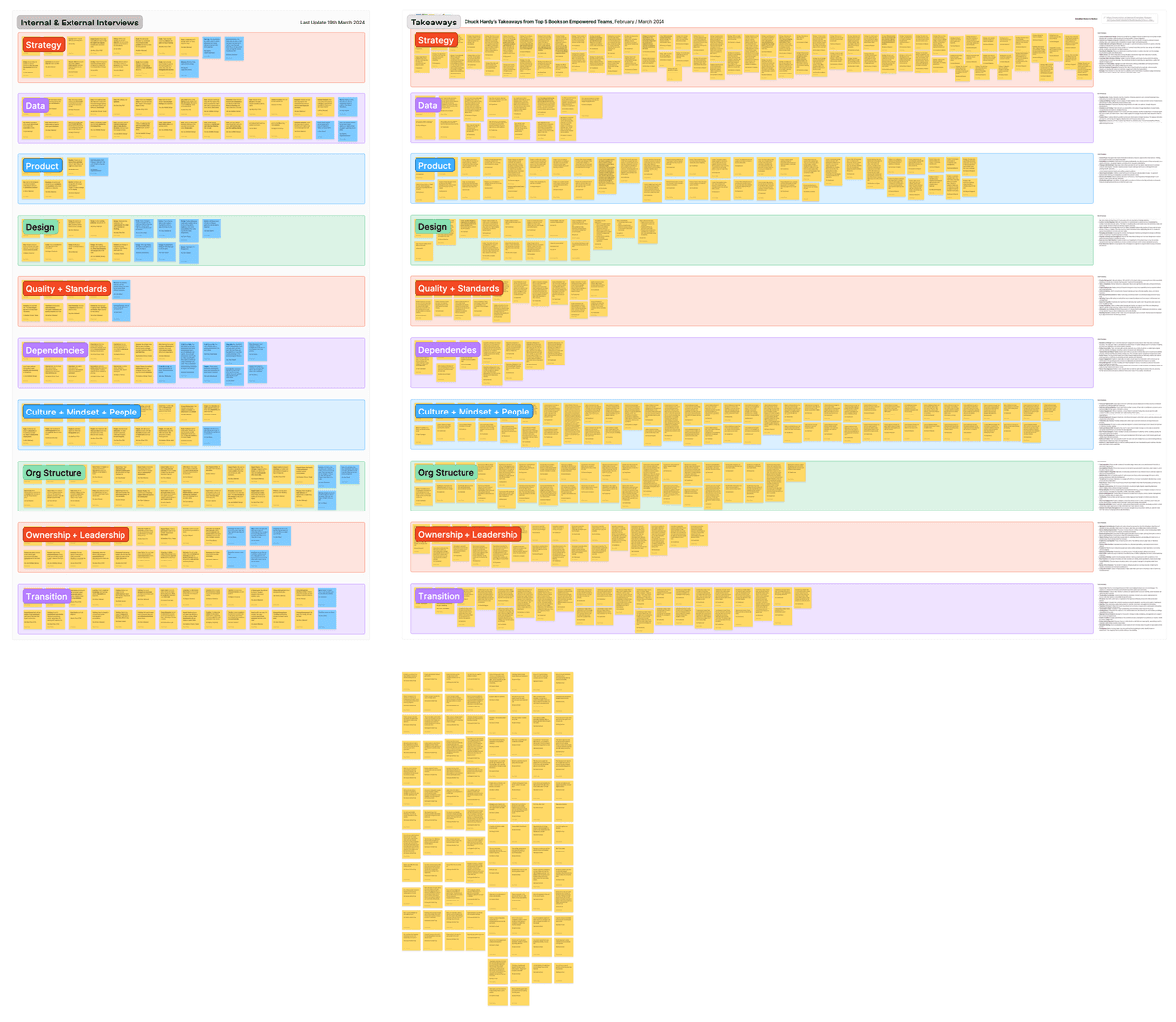
Then compare what people inside your company want with what other companies do. Most of the ladders I compared covered the same ground, so the gap was elsewhere. The engineers I interviewed wanted more: a tool they could use every day, simple, up to date and full of examples. My own retrospective added two goals: less time on management, and people who own their careers.
Decide what the path is for
Write down what the path must do before you write a single trait. I wrote design guidelines in three groups.
- Style: describe outcomes and traits. Keep the path easy to understand, remember and teach. Give each level a scope, focus areas and examples.
- Usage: show people how to use the path well. Each person tracks their own progress. Leaders use it in calibrations and reviews.
- Levels: each level builds on the one below, and the path shows how the tracks connect. It makes the next step clear and shows the options to move sideways. It stays realistic, keeps the standard high and changes as the company grows.
Some of these guidelines conflict. Short lines are easy to remember, but examples add text. I kept the path in two versions: one with the examples, and a short one without.
Seth Godin describes culture in This Is Marketing with one line: "People like us do things like this." A career path writes that line down for each level.
Start with the most senior level
Start at the top on purpose. Imagine a principal engineer who is the only person in the company with their skills. They do every job that needs those skills. Now hire a second person. The principal delegates part of the work, and that gives them capacity for more. Hire a third and a fourth, and the same thing happens each time.
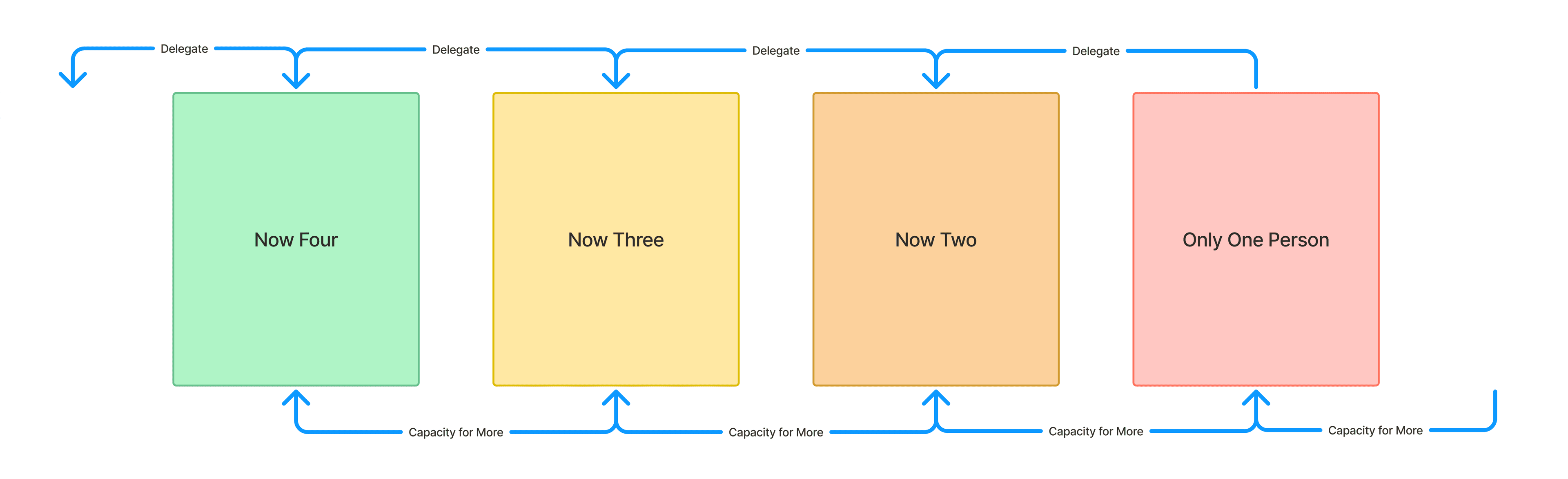
Each level is the work that the level above handed down, plus the room that this created. So describe the principal engineer first, then work down. At each level, ask what it keeps and what it hands on as the team grows.
Define the levels and their scope
Choose the number of levels that fits your company. I used six levels for individual contributors. Each level has a scope and the kind of work it is ready to own. To make scope easy to remember, I put each level on a map.
| Level | Scope | Ready to own |
|---|---|---|
| Associate Engineer | A house: one task at a time | A small feature with a clear spec |
| Engineer | A neighbourhood: a project | A piece of work that spans several features |
| Senior Engineer | A town: the whole team | A big project that needs other teams |
| Staff Engineer | A city: a product line | A team to lead |
| Senior Staff Engineer | A country: several product lines | A team or a product area to lead |
| Principal Engineer | A continent: many departments | A team or a product area to lead |
Roughly, associates have less than a year of experience. Engineers have one to four years, senior engineers four to seven and staff engineers seven or more.
Each level also has focus areas. Associates and engineers focus on execution, and execution stays on the list at every level. Senior engineers add team efficiency, domain expertise and mentorship. Staff engineers add technical leadership, technical excellence and expert knowledge of the company's stack. Senior staff engineers move to leadership, strategy and mastery. Principal engineers add deep knowledge of the market and of what is possible.
Line the path up with your other tracks too. From senior engineer up, each level sits next to a level for engineering managers, from associate manager to director. Product managers have an equal level at every step. A staff engineer and an engineering manager both look after a city. From staff level up, the path shows where people can move between the product and engineering manager tracks.
Cover sideways moves in your FAQ. Skills often transfer, a period to adjust is normal and what matters most is how fast someone learns.
Choose a few outcomes and rank them
Choose a few outcomes and put them in priority order. I chose five. The test for the order is simple: if you did only the first outcome, you would still likely succeed. Then ask which outcome, done well, would most raise your chances next.
| Outcome | In one line | Traits |
|---|---|---|
| 1. Impact | Spend your limited time where customers gain the most. | Customer centricity, critical thinking, value delivery, prioritisation |
| 2. Unified team | Work towards one shared goal, and spread what you learn. | Communication, sharing knowledge, collaboration, feedback |
| 3. Self-awareness and emotional intelligence (EQ) | Understand yourself, do what you promise and stay steady when the way ahead is unclear. | Reliability, trust, accountability, ambiguity |
| 4. Leadership | Help people get better, and leave behind a team that still gets better without you. | Decision making, scaling, alignment, mentorship, sponsorship |
| 5. Company thinking | Know how your work each day helps the business succeed. | Business sense, vision and mission, company goals |
The traits inside each outcome are in priority order too. After customer centricity, the next trait most likely to help is critical thinking.
In the written guide that goes with the path, each trait gets one paragraph. The paragraph on prioritisation argues that the work you turn down matters more to your success than the work you take on.
The path describes behaviour. It never says how to write code or a pull request. Tools and practices change fast, and a list of tasks goes out of date with them. The way a good engineer treats a customer, makes a decision or gives feedback lasts much longer. Put guidance on code and pull requests on a separate page. Technical skills belong in each role's job description, and promotion should depend mostly on leadership and impact.
Write short lines that add up
A career path holds a lot to take in. Mine has 20 traits across six levels. If you rewrite every line at every level, it becomes overwhelming. So look for ways to make it simpler. One way is to never repeat yourself: each level lists only what it adds.
Under each trait, every level gets a few lines. Each line is one short sentence that starts with a verb. The associate column marks its lines with ⊙, for the baseline that everyone follows at every level. Every other column marks its lines with ✚, for what that level adds. To see everything expected of you, read your column and every column to its left.
Here is an example of how one trait, customer centricity, can grow from one level to the next.
| Level | What this level adds |
|---|---|
| Associate Engineer | ⊙ Find out who uses the product and what problems it solves for them. ⊙ Know the service levels you promise customers, and keep them. |
| Engineer | ✚ Sit in on customer calls. ✚ Check what customers and Support say about the features you ship. |
| Senior Engineer | ✚ Speak up for the customer when the team makes decisions. ✚ Partner with Support and Customer Success. |
| Staff Engineer | ✚ Meet customers and partners whenever the chance comes up. |
| Senior Staff Engineer | ✚ Talk with customers yourself, and often. ✚ Join sales conversations before a deal closes. |
| Principal Engineer | ✚ Shape your strategy around what customers need. |
One line under value delivery shows the whole idea in a single row. A senior engineer predicts issues weeks in advance. A staff engineer predicts them months ahead, a senior staff engineer quarters ahead and a principal engineer years ahead.
Keep each line short enough to say out loud in a meeting. "Ask for help before a blocker costs you the afternoon." "Put your team's wins ahead of your own." "Take notes when nobody else does." "Argue with evidence, never with rank."
Borrow good ideas, and say where they come from. The decision-making lines in my path use Jeff Bezos's one-way and two-way doors. The prioritisation lines ask for appetites instead of estimates, an idea from Ryan Singer's Shape Up. The line "Have strong opinions; hold them weakly" adapts Paul Saffo's "strong opinions, weakly held".
Give every trait an example at every level
A short line is easy to remember and easy to misread. So give each level an example for every trait. Pick the examples from real situations in your company, and update them as new ones come up. An example helps people connect with the story behind the behaviour. Write each one as a scene from a normal week. Use "you", so the reader can picture themselves in it.
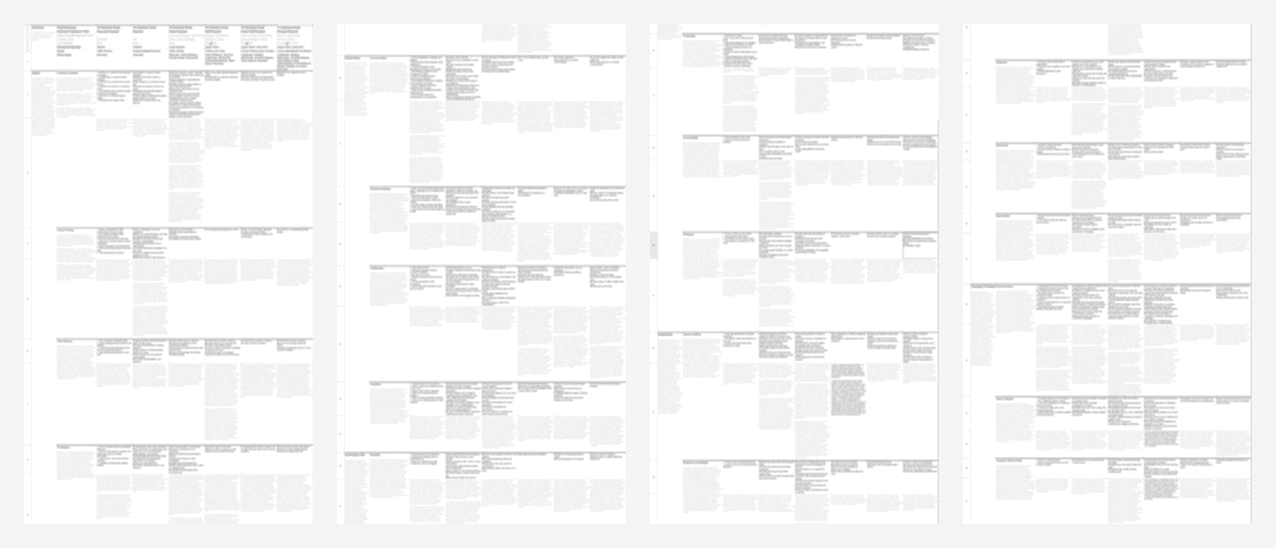
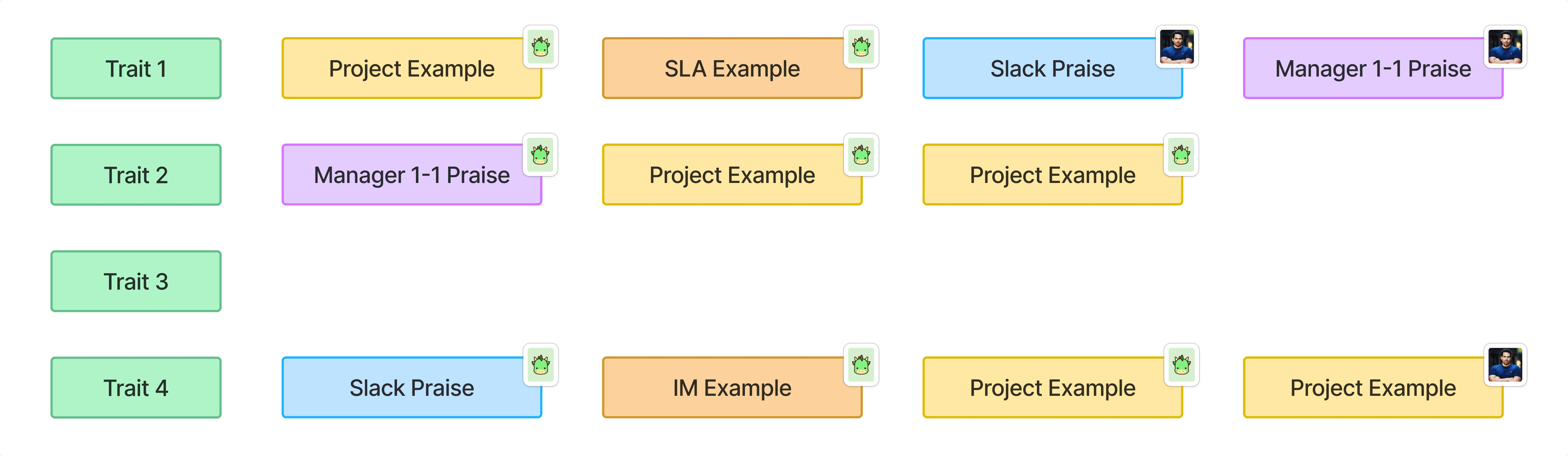
With an example for every trait at every level, the full path fills a long spreadsheet. A spreadsheet is also easy to load into an AI tool, so anyone can ask it questions about the path. The picture shows all of mine, cut into four parts that read from left to right.
Here is a scene for the same trait at each level.
| Level | Example |
|---|---|
| Associate Engineer | You pick up a bug ticket. Before you start, you find out which customers hit the problem and what it blocks for them. |
| Engineer | You read the support tickets about the billing page you shipped last month. Many customers misread one error message, so you rewrite it in plain words. |
| Senior Engineer | Your team plans a database upgrade for a Friday evening. You ask Support first and learn that several customers close their books that night, so you move the date. |
| Staff Engineer | Before a planning session, you join two customer calls. In the session, you share what you heard, and the team drops a feature nobody asked for. |
| Senior Staff Engineer | A prospect worries that the product won't scale for them. You join the sales call, walk them through how the system handles their load and note what they need. |
| Principal Engineer | You draft next year's technical strategy. Each big bet starts with the customer problem it solves, and you test the draft with three customers before you share it. |
Test the first version with managers and engineers
Once you have a first version, run workshops with managers, some in small groups and some in large ones. Aim to agree on two things: the order of priority, and what each line means in the work of a normal day.
Interview engineers at different stages of their careers too. Check that they understand the path and agree with it.
Write the guide that goes with it
The spreadsheet is the path. The guide explains how to read it and how to use it. Mine has these parts, in this order:
- A link to an anonymous feedback survey, right at the top.
- A short summary and the seven aims of the path.
- What the path gives the reader: a clear way to grow and fair treatment.
- Definitions of outcomes, traits, scope, ownership and focus areas.
- How to use the path, with a worked example.
- How calibrations work.
- How we built the path.
- An FAQ and a changelog.
My FAQ answers eight questions. To measure traits and outcomes, use evidence from the whole year: peer feedback, impact measures where you have them, manager observations and project outcomes. An engineer may be strong on technical skills but weak on behaviours. Give them a mentor, a training budget, clear feedback and reasonable time, because progression needs both.
Train managers, then show everyone how to use it
Train the managers first. Give each manager one-to-one training on how to teach the path to their team. Then teach engineers to use it as a tool for themselves: to see where they stand, choose what to work on and get better. Managers use the same path as their own tool, in reviews and in career development.
Make one point clear in every session: the path helps people grow, and nobody should treat it as a checklist. Nobody ticks off every line to earn a promotion. The lines describe how good engineers behave, and the examples show what that looks like. Growth shows up as a pattern in real work, backed by evidence over time.
The path only helps if people use it between reviews. Each engineer picks about five traits to work on at a time, together with their manager. Nobody can improve 20 traits at once.
Both the engineer and the manager collect evidence as they go. The engineer saves Slack threads, tickets and notes from customer calls. The manager notes what they see in meetings, feedback from colleagues and wins. At review time, every claim points to a trait and an example, and nobody has to rely on memory.
Calibrate as a panel
A career path is words on paper. Calibrations are where leaders agree how those words fit a real person. A panel of leaders, with the engineer's manager, agrees where the engineer is today. The panel also agrees where the engineer should be in six months, and what they need to focus on. I sum it up as "Align on the gap, show the gap, close the gap, repeat."
Plan the switch from the old version
If people worked to an old ladder all year, don't judge that year against the new path. Review the past year with the old ladder. Use the new path for the part of each review that looks ahead.
Where to start
Start with your own company's context. Then write the most senior level with your own leaders, and test each level against the engineers you have today, in workshops and interviews.
If the most senior engineer in your company were the only person with their skills, what would you write in their column?