
Helping Engineers Understand Their Emotions
Prefer to listen? Here is a podcast-style version of this article.
Of the many emotional intelligence strategies and tactics I read about, two frameworks seem to help me most, and they help others too. I shared them dozens of times with engineers who struggled to accept a mistake or felt overwhelmed. Many told me the frameworks made a difference.
When a mistake or a sharp comment stays with you, run six letters in the pause before you react: WPABSL, from Don Miguel Ruiz's agreements. If the thought is still there that night, write it down and test it with ANTs, short for automatic negative thoughts.
- Say what you mean, to your team and to yourself, and speak up when you disagree.
- Criticism says as much about the other person as about you, so take the truth and leave the emotional charge.
- Ask before you assume, even when the question feels basic.
- Your best changes with your state, so expect less in a hard week, from yourself and from your team.
- Doubt your inner voice as much as anyone else's, then listen until the other person finishes.
- Use the agreements to stay calm, never as a reason to skip a hard conversation or to overwork.
- Ask if the negative thought is true, then ask if it is really true.
- Put a kinder version of the thought through the same test. If the negative thought is true, act on it instead.
What are the Four Agreements and the Fifth Agreement
Don Miguel Ruiz published The Four Agreements in 1997. He presents them as Toltec wisdom, a guide to personal freedom. In 2010, he and his son, Don Jose Ruiz, added The Fifth Agreement.
Ruiz argues that we all live by agreements we never chose. We absorb them as children and from the people around us, and many of them limit us. The five agreements are:
- Be impeccable with your word: clarity and integrity in what you say.
- Don't take anything personally: freedom from other people's opinions and actions.
- Don't make assumptions: a clear mind and honest relationships.
- Always do your best: release from harsh self-judgement and regret.
- Be skeptical, but learn to listen: protection from limiting beliefs, and a connection with other people.
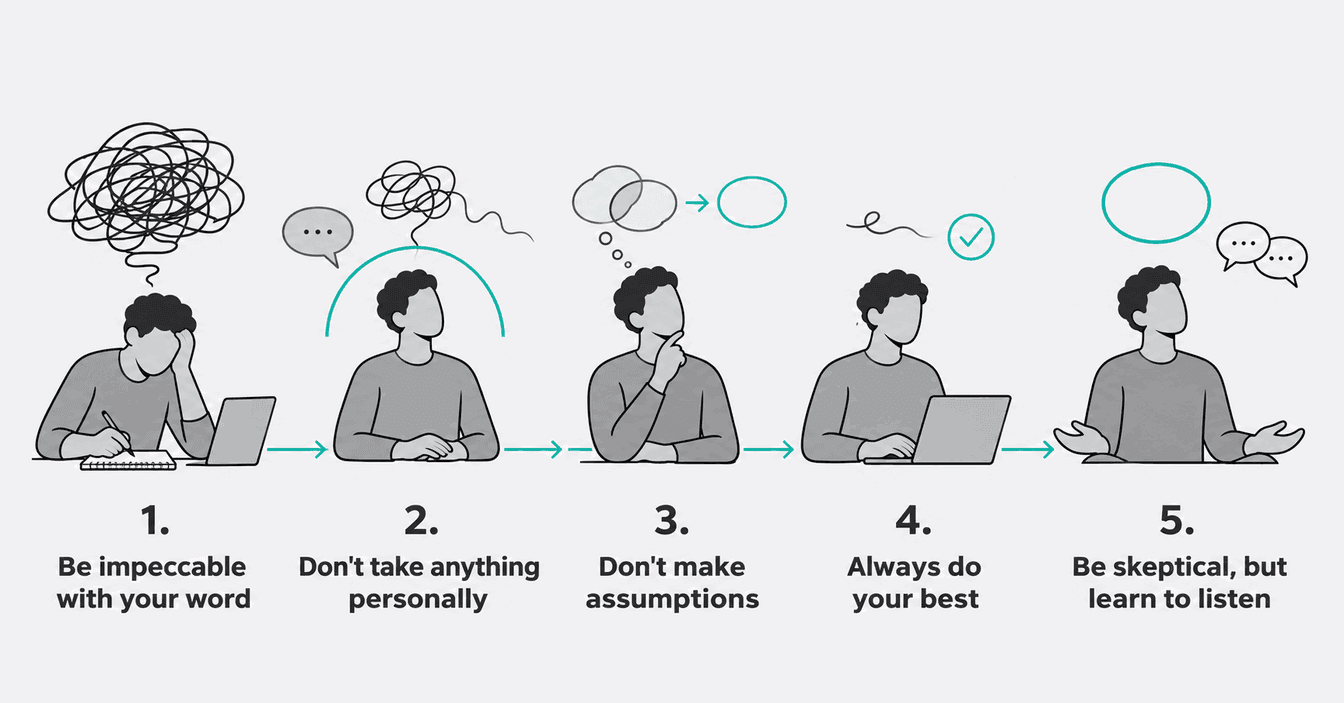
WPABSL has six letters for five agreements. W, P, A and B cover the first four. S and L split the fifth in two to help me remember. Each letter comes with one key question. The question doesn't make a feeling go away. It gives me a moment to look at the feeling before I act on it.
W: Be impeccable with your word
Ruiz asks you to say only what you mean and never to use words against yourself or others. Words can build or destroy, and a leader's words carry extra weight. A passing remark from a manager can stay with someone for months. When a leader gossips, the team learns that they will be the topic once they leave the room.
The agreement also covers the words you use on yourself. "I always mess this up" is a sentence you would never say to someone on your team. Plenty of us say it to ourselves.
To be impeccable with your word also means to speak your truth, most of all when the truth is uncomfortable. Silence can break this agreement as easily as a harsh comment. If I disagree with a decision and keep quiet to avoid friction, my word is not impeccable.
The key question is whether my words create something or cause harm.
P: Don't take anything personally
The second agreement is the mirror of the first. Ruiz argues that what others say and do comes from their own reality, not from you. Their words reflect their own agreements, not your worth. A sharp message from a stressed executive says more about the executive's week than about you.
When you take things personally, it costs you. You become easy to manipulate, and every comment turns into a verdict on who you are. For a leader, the cost spreads. A manager who takes criticism personally gets defensive, and the team learns to stop giving feedback.
The practice is to take any truth from the criticism and leave the emotional charge. It also means you notice when a reaction is bigger than the thing that caused it. That gap tells you something about yourself, not about the comment.
The key question is whether this is about me or about the other person's view.
A: Don't make assumptions
Ruiz says we assume we know what others think and feel, and the result is misunderstanding, drama and conflict. Leaders make this mistake in both directions. We assume we know how someone on the team feels, and the team assumes they know what we think.
Most assumptions grow in silence. A leader assumes a quiet engineer is happy. The engineer assumes the leader sees they are unhappy and doesn't care. Neither one asks, and both stories grow.
The fix takes courage more than skill. Ask the question, even when it feels basic. Say what you need out loud, even when that makes you vulnerable. A leader who asks for what they want shows the team that it is safe to do the same.
The key question is whether I know this or assume it.
B: Always do your best
People misread this agreement more than the others. Ruiz says your best changes from moment to moment. Your best when you are rested is not your best when you are tired, ill or grieving. The agreement asks you to give what you can in that moment, then let go of self-judgement.
This is the agreement for a mistake you can't stop replaying. If you did your best with what you knew and what you had that day, guilt adds nothing. Learn what you can, then put it down.
For leaders, this is also a rule about what we expect from others. Your team's best in a hard week is not their best in a good one. A leader who asks for the best-day version every day creates the overwhelm they then have to manage. The standard is self-respect, not perfectionism.
The key question is whether I give what I can in this moment.
S: Be skeptical
The first half of the fifth agreement says don't believe anyone blindly, yourself included. Ruiz argues that what you believe about yourself is a story, not the truth. Most of what we believe about ourselves, we never chose or tested.
For leaders, the loudest voice to doubt is often the inner one. "I'm not ready for this role." "They will find out I don't know what I'm doing." These are beliefs, not facts, and they deserve the same doubt you give anyone else's claims.
Skepticism applies outward too. A confident opinion in a meeting is still an opinion. The practice is to examine the evidence before you form a conclusion, and to notice when you act on blind faith.
The key question is whether this is true or a belief I accepted without proof.
L: Learn to listen
The second half of the fifth agreement balances the first. Skepticism on its own turns into cynicism. The Ruiz family's site describes the call to listen as the next step after skepticism, not a replacement for it.
Listen with your ears, eyes and heart. In practice, that means you don't plan your reply while the other person talks. You notice their tone and body language, and what they avoid as much as what they say. Someone who says "it's fine" about the same thing three weeks in a row tells you something.
People can tell when you are present, and they can tell when you aren't.
The key question is whether I am present and hear the whole message. Hold the doubt until the other person finishes.
Where the Four Agreements fail at work
The agreements are rules for a person, not for a team. Applied without judgement, two of them do harm.
Don't take anything personally. This agreement can excuse behaviour you should address. If a colleague is rude to people on your team, your feelings are not the problem. The behaviour hurts the team, and a leader needs to deal with it. The agreement keeps you calm enough for that conversation. It is no reason to skip the conversation.
Always do your best. This agreement can read as permission to overwork. A team that hears "always do your best" as "always do your most" burns out. Ruiz's own text says your best changes with your state. Read it that way, and say it that way to your team.
The letters have a limit too. A conversation can pass all six and still go wrong. They support judgement; they never replace it.
What are automatic negative thoughts (ANTs)
Psychiatrist Aaron Beck described automatic thoughts in the 1960s, when he developed cognitive therapy. They arrive on their own and feel like facts. Psychiatrist Daniel Amen later named the negative ones ANTs. Amen borrows his questions from the author Byron Katie. She asks "Is it true?" and "Can you absolutely know that it's true?" Then she turns the thought around to its opposite.
The version I share follows the same idea in two stages, and you write down every answer. On paper, you get distance from the thought. In your head, the thought answers its own questions.
Stage 1: Examine the thought
Write the thought down word for word. Then answer five questions:
- Is it true?
- Is it really true?
- What are you thinking?
- What are you feeling?
- What are the outcomes of this thought?
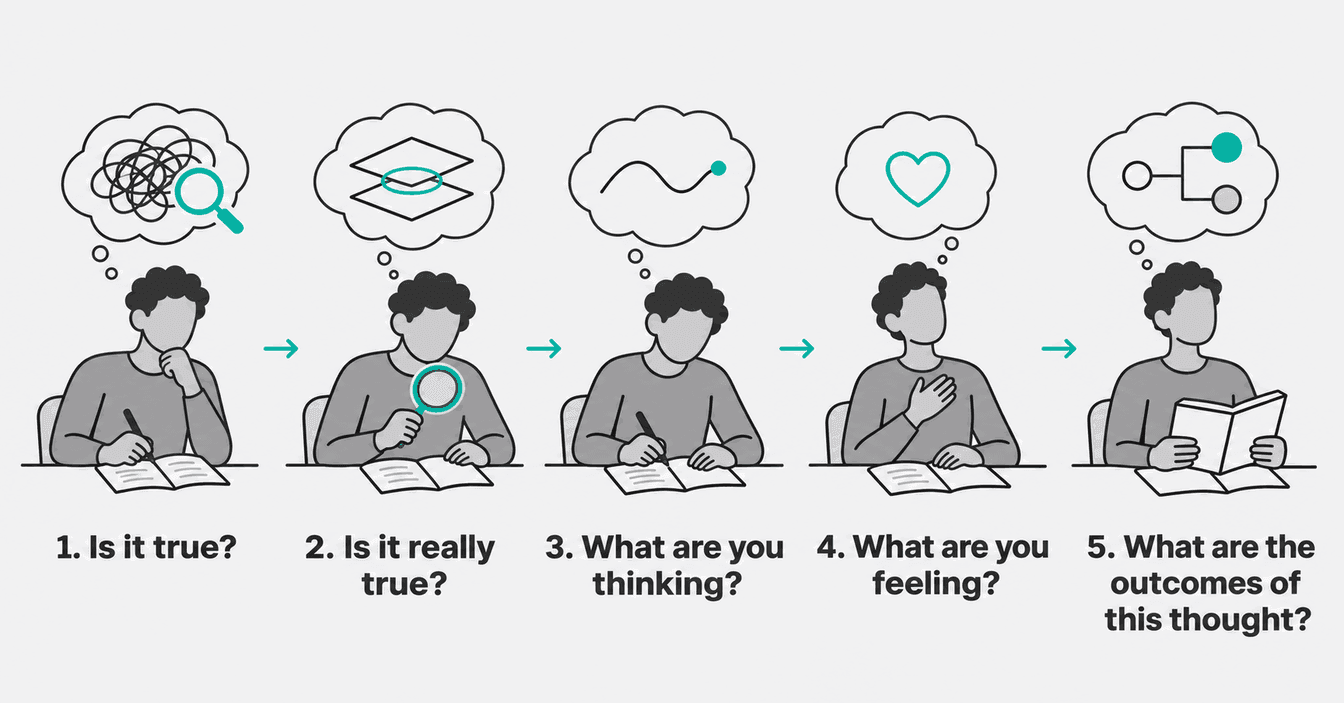
Your first answer to "Is it true?" comes from the feeling, so it is usually yes. The second question asks for evidence: the last time you thought this, and what happened. S in WPABSL asks it in the pause before you react. ANTs asks it twice, on paper, with time to find the evidence.
The third question asks for the thought under the first one. "I'll never finish this sprint" often sits on top of "I'm not good enough for this job."
Stage 2: Flip the thought
Write a kinder version of the thought, one you could defend to a friend. Then answer four questions:
- What would you think?
- What would you feel?
- Is it true?
- What are the outcomes of this thought?
The third question tests the flip. The kinder thought has to pass the same truth test as the negative one.
ANTs has limits too. If the negative thought passes both truth tests, don't flip it. Act on it: change the plan or ask for help. ANTs helps with a bad night, but it does not replace a doctor or a therapist. If the same thoughts come back every night for weeks, talk to one.
How I use WPABSL and ANTs day to day
WPABSL lives in my head, not on a sticky note. I say the six letters to myself when I work through my own emotions. They work because they are short: six letters fit in the pause before you react. Ruiz's books take longer and go deeper than six letters can.
ANTs is slower, and it needs a pen. I share it for the thought that is still there at night. WPABSL helps you react well; ANTs helps you let go.
Think of the last comment that stayed with you for the rest of the day. Run the six letters over it. If it still hurts that night, write it down. Is it really true?